
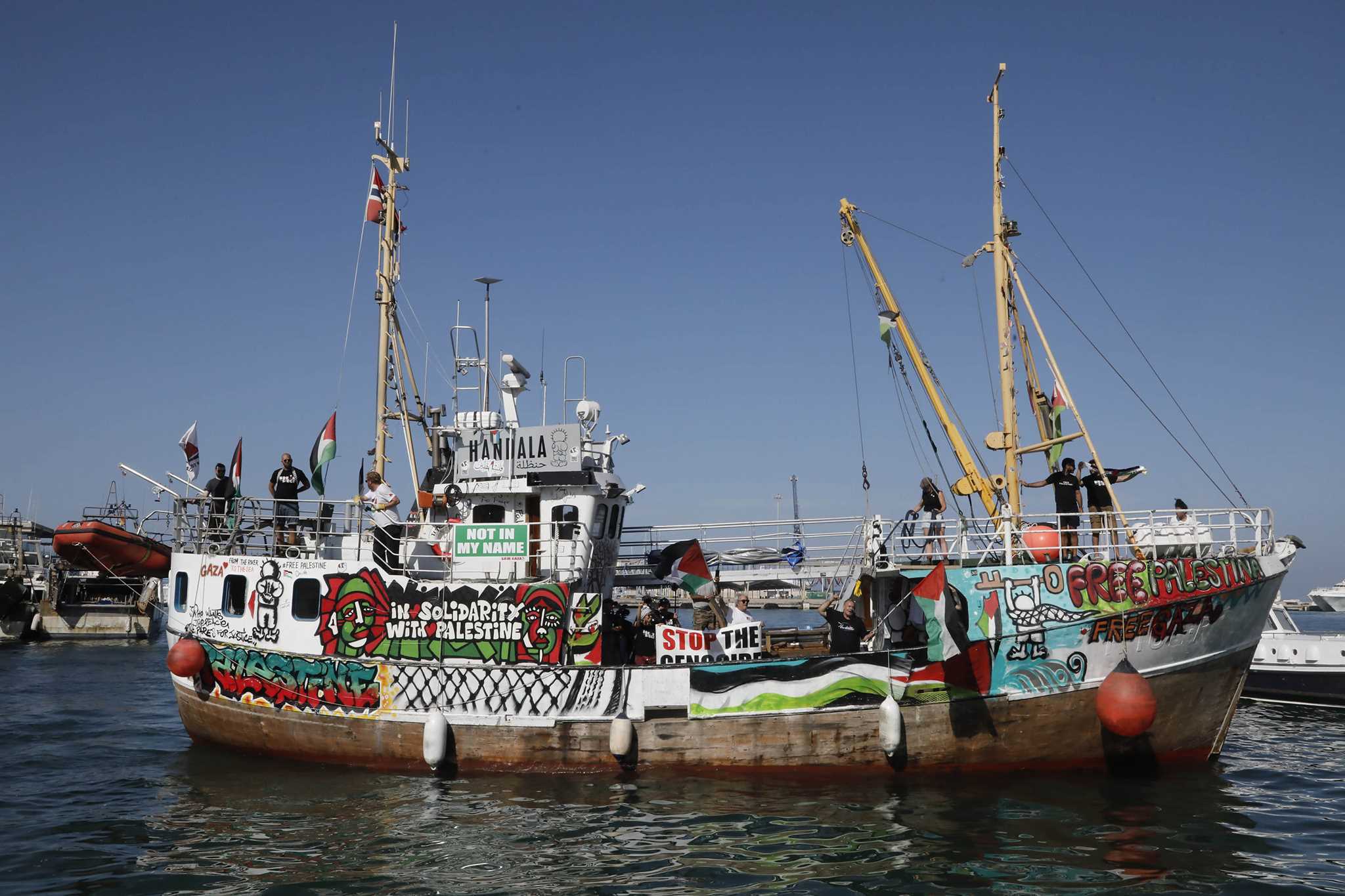
Intervention in the Name of Hope: Hanzala
Bedrihan Güneş 29.09.2025
Hanzala Intervention: The Forced Stopping of a Civilian Initiative in International Waters.
In 2025, the Hanzala, a vessel of the Freedom Flotilla, was subjected to sabotage and an Israeli intervention in international waters while carrying humanitarian aid from Italy to Gaza. Activists from 12 countries were detained and subjected to violence. Although the unlawful intervention sought to suppress solidarity, global support continues to grow.
In 2025, the Hanzala set sail from Italy toward Gaza as part of a civilian humanitarian aid initiative organized by the Freedom Flotilla Coalition. The vessel’s primary objective was to challenge the ongoing blockade of the Gaza Strip by sea and deliver humanitarian aid to the region. As part of this mission, 21 volunteer activists, journalists, healthcare workers, and human rights defenders from 12 different countries joined the voyage. Hanzala carried not only humanitarian supplies but also became a symbol of global solidarity, civil resistance, and the call for adherence to international law. The supplies on board included baby formula, diapers, medicine, and basic food items. Participants included Christian Smalls, founder of the Amazon Workers Union; human rights lawyer Huwaida Arraf; Jewish-American anti-war activists; members of the European Parliament; and Al Jazeera correspondents Mohamed El Bakkali and Waad Al Musa.

Sabotage Attempts Before the Voyage Before beginning its journey, the Hanzala faced two separate sabotage attempts. Technical inspections revealed ropes deliberately entangled around the vessel’s propeller. Had this been overlooked and the engine started, the ship’s propulsion system would likely have suffered serious damage, potentially leaving the vessel unable to move. The second sabotage attempt targeted the water supplied to the vessel. Analysis revealed that sulfuric acid had been mixed into the water tank. Had this gone unnoticed, both the crew and volunteers could have suffered severe chemical burns and potentially life-threatening consequences. These attempts were considered attacks aimed not only at stopping a vessel but also at obstructing global solidarity and the delivery of humanitarian aid to the Palestinian people.
Intervention in International Waters Despite all the attempts to prevent its journey, the Hanzala continued on its course and was stopped by the Israeli military in international waters on July 27, 2025, where the vessel was boarded. At the time of the intervention, there were no weapons, military personnel, or illegal elements on board. Nevertheless, all passengers were detained, the camera systems were shut down, and communication with the outside world was cut off. This was the third military intervention by Israel against a Freedom Flotilla mission in 2025. Earlier, in May, four people were injured in an attack on the aid vessel Vicdan in European waters, while in June, another vessel, Madleen, was intercepted and its crew detained. The failure of the international community to adequately address this chain of interventions reveals the vulnerability of international law in the face of political power.
Legal Dimension and Human Rights Violations Under international maritime law, a state does not have the authority to intervene against civilian vessels sailing outside its territorial waters when they do not pose a threat. In particular, when such vessels are carrying only humanitarian aid and operating for peaceful purposes, there is no legitimate basis for such an intervention. In this context, the operation carried out against the Hanzala cannot in any way be considered legitimate or defensible under international law and fundamental human rights principles. The intervention constitutes serious legal and ethical violations and has caused deep concern in the conscience of the international community.
The Freedom Flotilla Coalition called for the immediate release of the detained activists and journalists. Coalition representative Ann Wright stated that the treatment of those detained was “arbitrary, unlawful, and contrary to international law.” The unjust violence suffered by Christian Smalls was particularly striking. Smalls was reportedly pinned to the ground by security forces, kicked, and subjected to severe physical violence. Visible marks were said to have appeared on the activist’s neck and back. Furthermore, the fact that six police officers surrounded Smalls while he was meeting with his lawyer points not only to an individual violation of rights but also to systematic pressure on the right to legal defense. Such practices are contrary to fundamental human rights and international legal norms. The treatment Smalls experienced was not merely an individual attack; it reflected a broader policy of suppression.
Hanzala’s Limited Visibility: A Comparison with the Madleen and Vicdan Experiences Although the Hanzala initiative was a symbol of humanitarian aid, it did not receive as much public attention as the Madleen. This situation, similar to the earlier experience of the Vicdan, raises questions about the differing visibility of civilian initiatives. There are several reasons for this: Lack of Media Appeal: The Madleen carried well-known politicians and activists and was supported by strong social media campaigns, which attracted greater attention from the international press. Although Hanzala also had prominent participants, this support did not generate the same level of global media interest. Overlapping Agendas: The intervention coincided with other regional crises that were occupying significant attention in the global public sphere, limiting its impact on the international agenda.
Strategic Communication Amid a Crowded Global Agenda: The communication and campaign activities carried out before and during the Hanzala initiative generated more limited visibility compared with the Madleen case. In particular, social media mobilization and the use of symbolic messaging remained relatively weak. This was largely connected to the conflict between Israel and Iran occupying the global agenda. Similarity to the Vicdan: Despite being a high-risk initiative, the Vicdan received limited media visibility. One of the main reasons was the adoption of a low-profile communication strategy after departing from the Tunisian port, with visibility postponed until after its departure from Malta. Just one day before mobilization was due to begin, the vessel was scheduled to dock at the Port of Malta to receive activists when the Israeli drone attack took place. Therefore, although Hanzala’s humanitarian mission and its exposure to an unlawful intervention were highly significant, the reasons it failed to become a major part of the public agenda demonstrate how communication strategies, the participation of global actors, and international media attention can be decisive.
Conclusion The intervention against the Hanzala was not merely an attempt to obstruct humanitarian aid to the Palestinian people; it also represented an effort to suppress international solidarity movements. Alongside the aid supplies carried by the vessel, its message of hope, solidarity, and commitment to human rights was also targeted. However, the intervention has not brought solidarity efforts to an end; on the contrary, it has contributed to making them more visible and widespread. Hanzala is not merely a vessel; it is a symbol of human dignity, borderless humanitarian responsibility, and peaceful resistance. These events have not deterred the Freedom Flotilla Coalition; rather, they have strengthened its determination to break the inhumane blockade of Gaza. This time, through the international Global Sumud Flotilla coalition, preparations continued for a September 2025 voyage into the Mediterranean, with the support of people from many different countries and 44 yachts, boats, and ships.